On this page
- What Should the Best CRM for Kia Car Dealers Include?
- How a CRM Helps Kia Dealers Manage Leads
- Why Follow-Up Management Matters for Kia Dealerships
- Managing the Kia Sales Pipeline With CRM Software
- How to Choose the Right CRM for a Kia Dealership
- Why Cyepro Can Be Considered for Kia Dealership CRM Needs
- Frequently asked questions
Key takeaways
- Connect enquiries from every lead source into one dealership workflow.
- Give salespeople clear ownership, customer history and next actions.
- Evaluate CRM software with a real Kia customer journey.
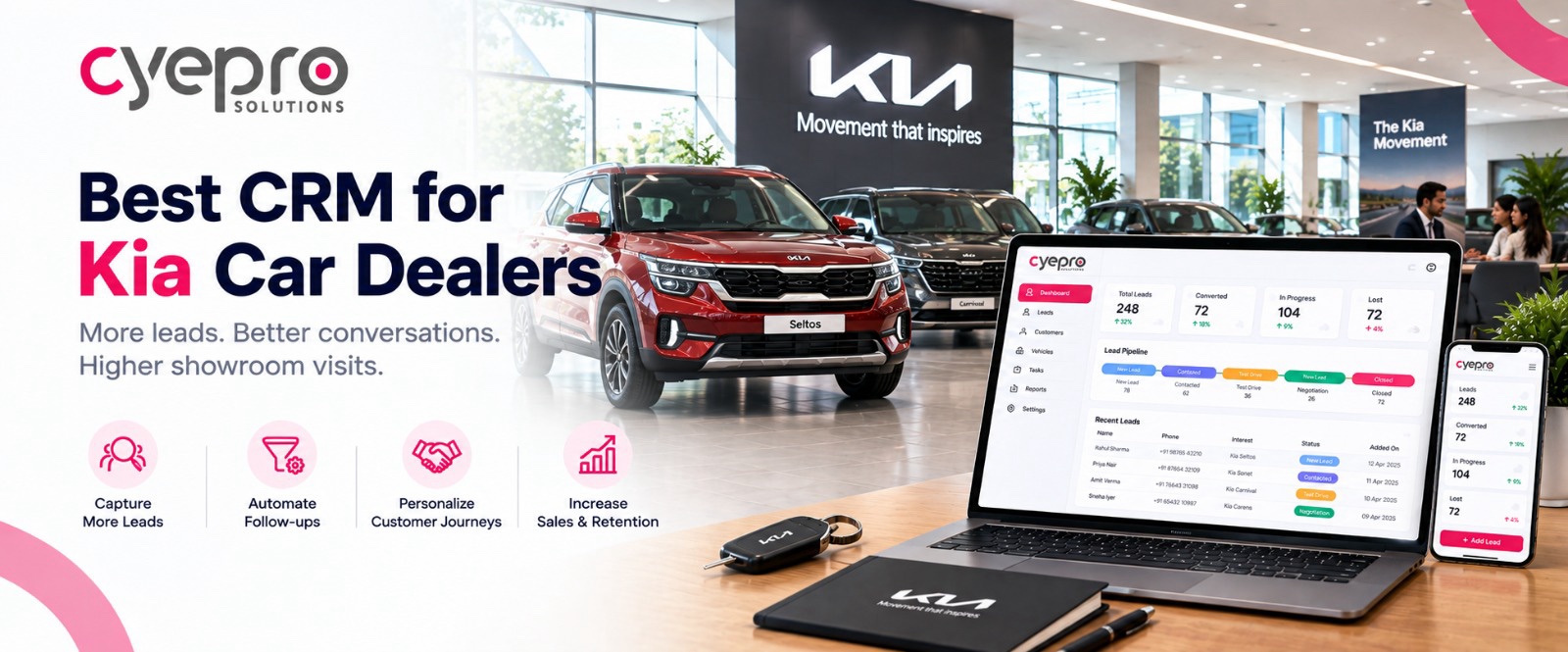
Choosing the best CRM for Kia car dealers is about more than storing customer contact details. Kia dealerships manage enquiries from websites, digital campaigns, social media, automotive portals, phone calls, and showroom visits. A dealership-focused CRM can bring these enquiries into one workflow, help sales teams manage follow-ups, track opportunities, and give managers visibility into the sales pipeline. Cyepro is an automotive crm platform designed for car dealerships, with tools focused on lead management, customer management, follow-ups, sales pipelines, communication, and reporting.
The right Kia dealership CRM should support the complete customer journey - from the first enquiry through follow-up, test drive, quotation, booking, and delivery.
What Should the Best CRM for Kia Car Dealers Include?
Kia dealerships may handle enquiries across different models, variants, budgets, and customer requirements. Sales teams need a system that makes it easy to understand each opportunity and determine the next action.
Important CRM capabilities include:
- Multi-source lead capture
- Lead assignment
- Customer and enquiry management
- Follow-up scheduling
- Test-drive management
- Sales pipeline tracking
- Customer communication
- Lead-source tracking
- Sales team activity monitoring
- Reporting and analytics
A CRM should also make customer information accessible to the salesperson responsible for the enquiry.
For a broader overview of automotive CRM capabilities, see our guide to automotive CRM for car dealerships.
Read Also: Automotive CRM Guide for Car Dealerships
The goal is to create a consistent workflow where salespeople know which customers need attention, what has already happened, and what action should happen next.
How a CRM Helps Kia Dealers Manage Leads
Kia dealers can receive enquiries through multiple channels. Managing each source separately can make it difficult to maintain a clear picture of the dealership's overall lead pipeline.
For example, a dealership could receive:
- A website enquiry for a Kia SUV
- A social media campaign enquiry
- A lead from an automotive marketplace
- A phone enquiry
- A showroom walk-in
- A referral from an existing customer
A dealership CRM can bring these opportunities into a structured workflow.
A typical process might look like:
- New Lead
- Assigned
- Contacted
- Qualified
- Test Drive
- Quotation
- Negotiation
- Booking
- Delivery
The exact stages can be adjusted according to the dealership's sales process.
A well-organised Kia dealer CRM also gives managers a clearer view of lead ownership and sales activity.
For more information, read our car dealership lead management guide.
Read Also: Car Dealership Lead Management: Complete Guide
Lead Assignment and Ownership
Once a lead enters the system, the dealership should be able to identify the salesperson responsible for it.
Clear ownership can make it easier to monitor activity and identify enquiries that have not received appropriate attention.
Instead of asking several salespeople whether someone has contacted a customer, managers can check the CRM record and review the activity associated with the lead.
Why Follow-Up Management Matters for Kia Dealerships
Not every Kia customer is ready to purchase immediately.
A customer may enquire about a vehicle, compare variants, discuss pricing with family, request a test drive, explore financing, or consider an exchange before making a final decision.
That means Kia dealership lead follow-up needs to be organised.
A CRM can help salespeople keep track of follow-up activities and customer interactions.
For example:
- Day 1: Customer submits a Kia vehicle enquiry
- Day 1: Salesperson makes the first contact
- Day 2: Customer requests additional information
- Day 4: Test drive scheduled
- Day 5: Test drive completed
- Day 7: Quotation shared
- Day 10: Follow-up scheduled
Instead of relying on memory, the sales team can work from a structured customer record.
Our car dealership lead follow-up guide provides more guidance on creating a consistent follow-up process.
Read Also: Car Dealership Lead Follow-Up: Complete Guide
Follow-Up Visibility for Sales Managers
Managers also need to know which leads are:
- New
- Contacted
- Pending
- Overdue for follow-up
- In negotiation
- Ready for booking
- Closed
This visibility can help sales managers identify where additional attention may be required.
Managing the Kia Sales Pipeline With CRM Software
A dealership CRM should make the Kia sales pipeline easier to understand.
Rather than maintaining a spreadsheet with customer names and manually updating statuses, dealerships can organise opportunities according to their current stage.
For example:
| Sales Stage | Example |
|---|---|
| New Lead | New Kia enquiry received |
| Contacted | Initial conversation completed |
| Qualified | Customer requirement identified |
| Test Drive | Test drive requested or completed |
| Quotation | Price or offer shared |
| Negotiation | Customer discussing purchase |
| Booking | Customer moving toward booking |
| Delivery | Vehicle delivery process |
This gives sales managers a structured view of active opportunities.
It can also help identify where customers are getting delayed. If a large number of enquiries remain at the same stage, the dealership can investigate the process and determine what may be preventing them from progressing.
For a deeper look at pipeline management, explore our automotive sales pipeline guide.
Read Also: Automotive Sales Pipeline: Complete Guide
Customer history is another important part of CRM. When a customer contacts the dealership again, the salesperson should be able to see relevant previous interactions instead of starting the conversation from scratch.
How to Choose the Right CRM for a Kia Dealership
When evaluating CRM software for Kia car dealers, don't compare platforms only by their feature lists.
Instead, test whether the CRM supports your actual dealership workflow.
1. Review Your Lead Sources
Identify every source currently generating enquiries.
Then determine whether the CRM can capture, organise, and track those leads effectively.
2. Evaluate Lead Follow-Up
Ask whether salespeople can easily identify:
- New enquiries
- Today's follow-ups
- Overdue follow-ups
- Upcoming appointments
- Customer responses
- Next actions
The system should make follow-up part of the normal sales workflow.
3. Check Customer Communication
Evaluate how the CRM handles communication through channels relevant to your dealership, such as phone calls, email, SMS, and WhatsApp.
The objective is to maintain useful customer context throughout the sales journey.
4. Examine Reporting
Sales managers may need visibility into:
- Lead volume
- Lead sources
- Salesperson activity
- Pipeline stages
- Pending follow-ups
- Conversion activity
- Customer engagement
Good reporting should help managers understand dealership activity without requiring extensive manual spreadsheet preparation.
5. Test the CRM With a Real Kia Customer Journey
During a CRM demonstration, use an actual dealership scenario.
For example:
A customer enquires about a Kia vehicle, requests a test drive, asks for a quotation, becomes unresponsive, and returns several days later.
Ask the CRM provider to demonstrate how the entire journey would be managed.
This gives your sales team a much better understanding of how the platform fits into daily operations.
For a broader CRM evaluation checklist, see our guide to CRM features for car dealerships.
Read Also: CRM for Car Dealerships: Key Features to Evaluate
Why Cyepro Can Be Considered for Kia Dealership CRM Needs
Cyepro is an automotive CRM platform designed for car dealerships and automotive businesses.
The platform focuses on dealership workflows such as:
- Lead management
- Customer management
- Lead-source tracking
- Follow-up management
- Sales pipeline management
- Test-drive management
- Customer communication
- Sales activity tracking
- Reporting and analytics
The purpose of an automotive CRM is not simply to store customer information. It should help connect lead generation, sales activity, customer communication, and follow-up into one structured process.
Kia dealerships evaluating CRM software can explore Cyepro automotive crm and assess the platform against their specific sales process.
The right CRM will ultimately depend on factors such as dealership size, lead volume, sales workflow, communication requirements, existing technology, and reporting needs.
Before choosing a platform, involve the people who will use it every day - including sales executives, BDC teams, sales managers, and dealership management.
Frequently asked questions
What is the best CRM for Kia car dealers?
The appropriate CRM depends on the dealership's workflow, lead sources, team requirements, communication channels, and reporting needs. A dealership-focused automotive CRM should support lead management, customer records, follow-ups, sales pipelines, and reporting.
Why should Kia dealers use a CRM?
A CRM can help Kia dealerships organise enquiries, assign leads, track customer interactions, manage follow-ups, and monitor opportunities throughout the sales process.
What features should a Kia dealership CRM have?
Important capabilities include lead capture, lead assignment, customer management, follow-up tracking, test-drive management, sales pipeline management, communication, reporting, and analytics.
Can CRM software manage leads from different sources?
Many automotive CRM platforms can centralise leads from multiple sources. The specific sources and integrations available depend on the CRM platform.
How can CRM improve Kia dealer lead follow-up?
A CRM can provide salespeople with visibility into pending activities, customer history, reminders, and next actions, creating a more structured follow-up process.
Is Cyepro an automotive CRM for car dealerships?
Yes. Cyepro is positioned as an automotive CRM platform designed for dealership workflows, including lead management, customer management, follow-ups, sales pipelines, and reporting.