On this page
- Why Hyundai Dealerships Need More Than a Customer Database
- How Hyundai Dealers Can Organise Leads From Different Channels
- Managing Hyundai Model and Variant Enquiries More Effectively
- From Test Drive to Booking: Tracking the Sales Journey
- What Should Hyundai Dealership Managers Look for in CRM Reports?
- How to Choose CRM Software for a Hyundai Dealership
- Why Cyepro Can Be Evaluated by Hyundai Dealerships
- Frequently asked questions
Key takeaways
- Give every active enquiry a visible status, owner and next action.
- Keep model preferences, customer interactions and test-drive follow-ups together.
- Evaluate CRM software using your Hyundai dealership's real sales process.
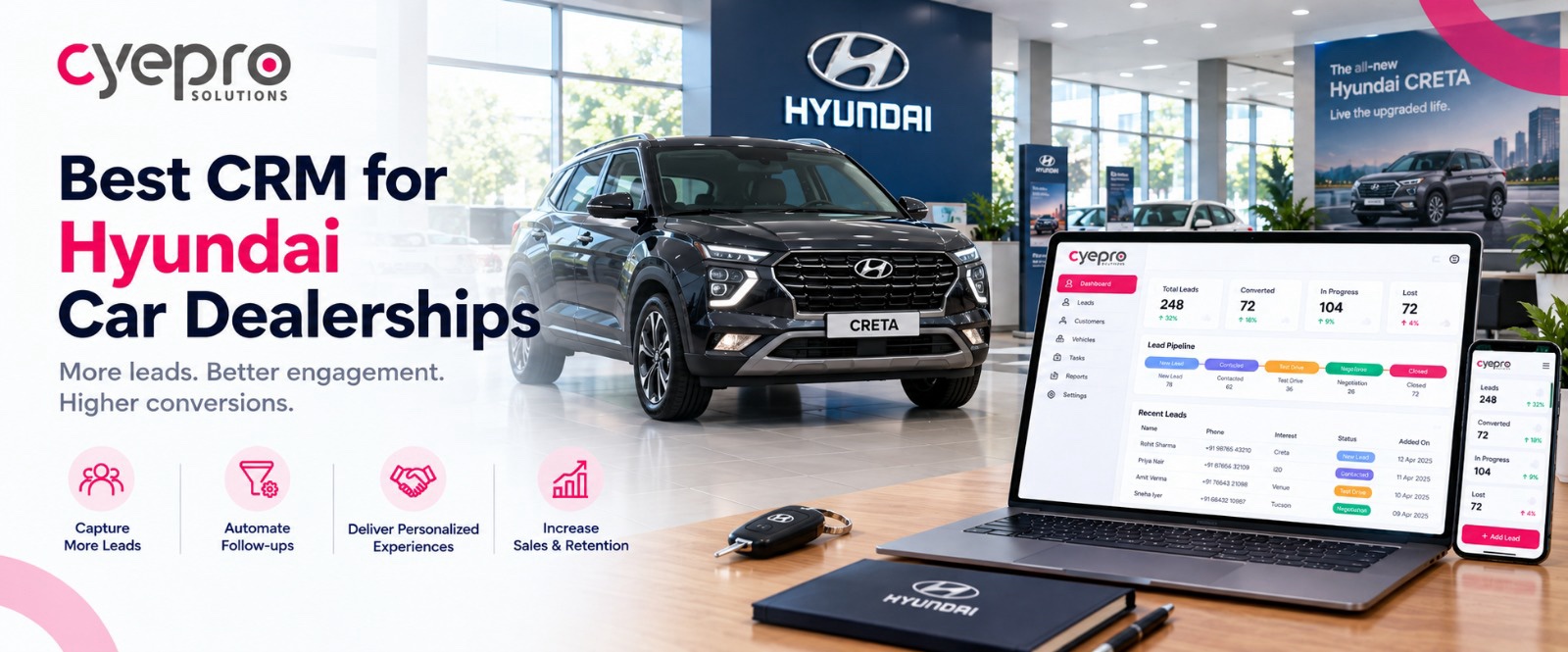
For a Hyundai dealership, every customer enquiry represents a potential sales opportunity, but managing those opportunities becomes difficult when leads arrive from websites, advertising campaigns, social media, automotive portals, phone calls, and showroom visits. A dealership CRM can help bring these enquiries into one organised system, allowing sales teams to track customer requirements, manage follow-ups, coordinate test drives, and monitor opportunities. Cyepro is an automotive crm platform designed for car dealerships, helping connect lead management, customer information, sales activity, follow-ups, and reporting in one workflow.
If you're searching for the best CRM for Hyundai car dealerships, the important question is not simply which software has the most features. The better question is whether the CRM helps your dealership respond to customers, maintain context, and move opportunities through the sales process efficiently.
Why Hyundai Dealerships Need More Than a Customer Database
A customer database tells you who your customers are. A dealership CRM should also tell your team what needs to happen next.
Consider a Hyundai dealership receiving enquiries throughout the day. One customer may be asking about an SUV, another may want a hatchback, another may be comparing variants, and another may already be ready for a test drive.
Each customer is at a different point in the buying journey.
A useful CRM can connect:
- Customer enquiry
- Requirement
- Salesperson
- Interaction
- Follow-up
- Test drive
- Quotation
- Opportunity
- Booking
This gives salespeople a clearer picture of active customers.
It also helps managers understand whether enquiries are being acted on or simply accumulating in the system.
For an introduction to dealership CRM systems, see our automotive CRM guide for car dealerships.
Read Also: What Is Automotive CRM? A Complete Guide for Car Dealerships
A CRM Should Answer the Next-Action Question
One of the most useful questions a sales executive can ask is:
What do I need to do next?
A good CRM should make that answer easy to find.
The next action might be:
- Call the customer
- Share vehicle information
- Confirm a showroom appointment
- Schedule a test drive
- Send a quotation
- Follow up after a test drive
- Reconnect with an inactive opportunity
When next actions are visible, customer management becomes more systematic.
How Hyundai Dealers Can Organise Leads From Different Channels
Modern dealership enquiries don't necessarily arrive in one place.
A Hyundai dealer may receive potential customers from:
- Website enquiries
- Google and digital campaigns
- Social media
- Automotive marketplaces
- Phone calls
- Walk-in customers
- Existing customer referrals
- Other marketing campaigns
If every source follows a different process, sales managers can struggle to maintain visibility.
A CRM can create a common workflow regardless of where the enquiry originated.
For example:
- Lead received
- Lead assigned
- Customer contacted
- Requirement identified
- Follow-up scheduled
- Test drive / showroom visit
- Quotation
- Sales opportunity
- Booking
The purpose of this workflow isn't to make every customer behave the same way. It is to ensure that every active opportunity has a visible status and owner.
Our car dealership lead management guide explains how dealerships can create a more structured approach to managing enquiries.
Read Also: Car Dealership Lead Management: Complete Guide
Lead Source Data Can Help Marketing Teams
A CRM can also connect lead activity with its source.
Instead of looking only at how many enquiries were generated, dealership teams can examine which sources are producing active opportunities.
This gives marketing and sales teams a shared view of lead performance.
Managing Hyundai Model and Variant Enquiries More Effectively
Vehicle buyers often have specific requirements.
A customer may be interested in:
- A particular Hyundai model
- A specific variant
- A preferred colour
- A particular budget
- An automatic or manual transmission
- A fuel type
- A new vehicle or exchange option
- A test drive
Recording these details in the CRM gives salespeople useful context before the next interaction.
Imagine a customer who enquired several days earlier but hasn't yet purchased.
Without customer history, a salesperson may need to ask basic questions again.
With a structured CRM record, the salesperson can review the previous enquiry, understand the customer's requirement, check previous communication, and continue the conversation.
This creates a more connected customer experience.
Why Customer Context Matters
A CRM record should ideally provide a useful picture of the customer's journey.
For example:
- Customer interested in a Hyundai SUV
- Enquiry received
- Salesperson contacted
- Customer requested a test drive
- Test drive completed
- Quotation shared
- Follow-up pending
The salesperson immediately understands the current situation.
That is more useful than simply seeing a name and phone number in a database.
From Test Drive to Booking: Tracking the Sales Journey
The test drive can be an important point in the vehicle-buying journey.
But completing a test drive doesn't necessarily mean the customer is ready to book immediately.
The customer may want to:
- Compare another vehicle
- Discuss the purchase with family
- Review pricing
- Consider financing
- Evaluate an exchange
- Ask additional questions
- Wait before making a decision
A CRM can help salespeople maintain the relationship after the test drive rather than treating the activity as the end of the process.
For example:
- Test drive completed
- Customer feedback recorded
- Follow-up scheduled
- Additional information provided
- Quotation updated
- Negotiation
- Booking discussion
This gives managers visibility into opportunities after important customer interactions.
Our car dealership lead follow-up guide covers how structured follow-up can support the dealership sales process.
Read Also: Car Dealership Lead Follow-Up: Practical Guide for Teams
What Should Hyundai Dealership Managers Look for in CRM Reports?
CRM reporting should help dealership managers understand what is happening without requiring every salesperson to prepare separate spreadsheets.
Useful information can include:
- Lead volume - How many enquiries are entering the dealership?
- Lead distribution - How are enquiries being allocated across salespeople?
- Follow-up status - Which customers require action?
- Sales pipeline - How many opportunities are at each stage?
- Lead sources - Which channels are producing enquiries?
- Sales activity - How actively are salespeople managing their assigned opportunities?
These reports can help management identify process gaps.
For example, if a large number of leads are entering the CRM but many have no recent activity, the dealership may need to examine its lead assignment or follow-up process.
If many opportunities reach the quotation stage but remain there, management can review those customer journeys to understand what is happening.
This is where an automotive CRM becomes a management tool rather than simply a contact database.
For more information, explore our guide to automotive sales pipeline management.
Read Also: Automotive Sales Pipeline: Complete Guide for Dealerships
How to Choose CRM Software for a Hyundai Dealership
There is no universal CRM that fits every dealership in exactly the same way.
When evaluating the best CRM for Hyundai dealers, start with your own workflow.
1. Test Lead Capture
Ask the CRM provider how enquiries enter the system and how quickly they become visible to the sales team.
2. Test Lead Assignment
Find out how new enquiries are assigned and how managers can monitor ownership.
3. Test Follow-Up
Create a sample customer and schedule several activities.
Can the salesperson easily see what needs to happen today?
4. Test Customer History
Add multiple interactions to one customer record.
Can the salesperson quickly understand the customer's journey?
5. Test Pipeline Management
Move a sample opportunity through different stages.
Can managers easily see where active opportunities are?
6. Test Reporting
Ask the provider to show reports using realistic dealership data.
The objective is to understand whether the reports actually help managers make operational decisions.
For a broader evaluation checklist, see our guide to CRM features for car dealerships.
Read Also: CRM for Car Dealerships: Key Features to Evaluate
Why Cyepro Can Be Evaluated by Hyundai Dealerships
Cyepro is an automotive CRM platform designed for car dealerships and automotive businesses.
The platform brings together dealership-focused workflows including:
- Lead management
- Customer management
- Lead-source tracking
- Follow-up management
- Sales pipeline tracking
- Test-drive management
- Customer communication
- Sales activity
- Reporting and analytics
For a Hyundai dealership, the value of a CRM should be evaluated by looking at how these functions work together.
A new enquiry should not remain isolated from the rest of the customer journey.
The dealership should be able to move from lead to customer interaction, follow-up, test drive, opportunity and booking while maintaining relevant customer information throughout the process.
You can explore the automotive crm and evaluate how its dealership-focused workflow aligns with your sales operation.
The final CRM decision should take into account your dealership's size, enquiry volume, team structure, communication requirements, existing systems, integrations, and reporting needs.
Frequently asked questions
What is the best CRM for Hyundai car dealerships?
The right CRM depends on the dealership's workflow and operational requirements. Hyundai dealers should evaluate lead management, customer records, follow-ups, test-drive tracking, sales pipelines, communication, reporting, and usability.
What does CRM software do for Hyundai dealers?
A CRM can help Hyundai dealerships capture and organise enquiries, assign leads to salespeople, record customer interactions, manage follow-ups, track opportunities, and monitor sales activity.
Can a Hyundai dealership CRM manage leads from multiple sources?
Automotive CRM platforms can support multiple lead sources depending on their integrations and capabilities. Dealerships should verify that the platform supports the channels they currently use.
How does CRM improve Hyundai dealership lead follow-up?
CRM software can connect customer records with activities, reminders, previous interactions, and next actions, giving salespeople a structured way to manage ongoing enquiries.
What features should Hyundai dealers look for in CRM software?
Important features include lead capture, lead assignment, customer management, follow-up tracking, test-drive management, sales pipeline management, communication, reporting, analytics, and integrations.
Can Cyepro be used as a CRM for Hyundai dealerships?
Cyepro is an automotive CRM platform designed for car dealerships and automotive businesses. Hyundai dealerships can evaluate the platform based on their own sales process and operational requirements.