On this page
- What is CRM in a car dealership?
- What is a dealer management system (DMS)?
- DMS vs CRM: a side-by-side comparison
- What CRM do most car dealerships use in India?
- Do you need a CRM, a DMS or both?
- How the OEM system, the DMS and the CRM connect
- The hidden cost of keeping them separate
- Buyer checklist: CRM or DMS
- Where Cyepro fits
- The bottom line
- Frequently asked questions
Key takeaways
- A CRM covers the sales front end, from first enquiry to booking.
- A DMS covers the whole dealership, and a good one has the CRM built in.
- Test any system with one real customer journey, from enquiry to delivery and RTO.
A CRM manages customers before the sale: enquiries, follow-ups, test drives and the sales pipeline. A dealer management system (DMS) runs the whole dealership: bookings, stock, invoices, delivery, RTO, accounts and reports, and a good one has the CRM built in. Most Indian dealers need both jobs done. The real question is whether one system does them or two.
That question matters more than the labels. Vendors use "CRM" and "DMS" loosely, and an owner comparing software can end up buying a lead tool when the real pain is in bookings and deliveries, or a heavy back-office system that the sales team never opens. This guide explains what each one does in an Indian car showroom, where they overlap, how they connect with your carmaker's system and how to decide what your dealership actually needs.
What is CRM in a car dealership?
CRM stands for customer relationship management. In a car dealership, the CRM is the system the sales team uses to handle people who have not bought yet. For every enquiry it answers four questions: who is this customer, where did they come from, who owns them and what happens next.
A dealership CRM typically covers:
- Lead capture from walk-ins, phone calls, the dealer website, Facebook and Instagram ads, and portals such as CarDekho and CarWale
- Lead assignment, so every enquiry has one named sales consultant (DSE)
- Follow-up tasks with dates, so calls do not depend on memory
- Test drive scheduling and the outcome of each drive
- Pipeline stages from enquiry to booking, with a lost reason when a customer drops out
- Basic dashboards on enquiries, sources and conversion
A CRM is about the front of the funnel. It is very good at making sure nobody forgets a customer, and it usually stops at the moment the customer pays the booking amount.
For a closer look at the front end, read our car dealership lead management guide.
What is a dealer management system (DMS)?
A dealer management system is the operating system for the whole dealership. It starts where the CRM starts, with the enquiry, but it carries the same customer record through everything that happens after the booking:
- Booking, advance receipt and discount approval
- Vehicle allotment from stock, by model, variant and colour
- Invoice with the tax breakdown, and delivery with a checklist
- RTO registration tracking, from temporary number to number plate and RC handover
- New-car stock and stock ageing
- Used-car exchange evaluation
- Finance, insurance, accessories and extended warranty for each car sold
- Accounts entries, receipts and tax reports such as GST and TCS
- Targets, dashboards and MIS reports for managers and the owner
In short, a CRM tells you how many people want a car. A DMS tells you how many cars you booked, invoiced, delivered and registered, how much money came in, and what is still pending.
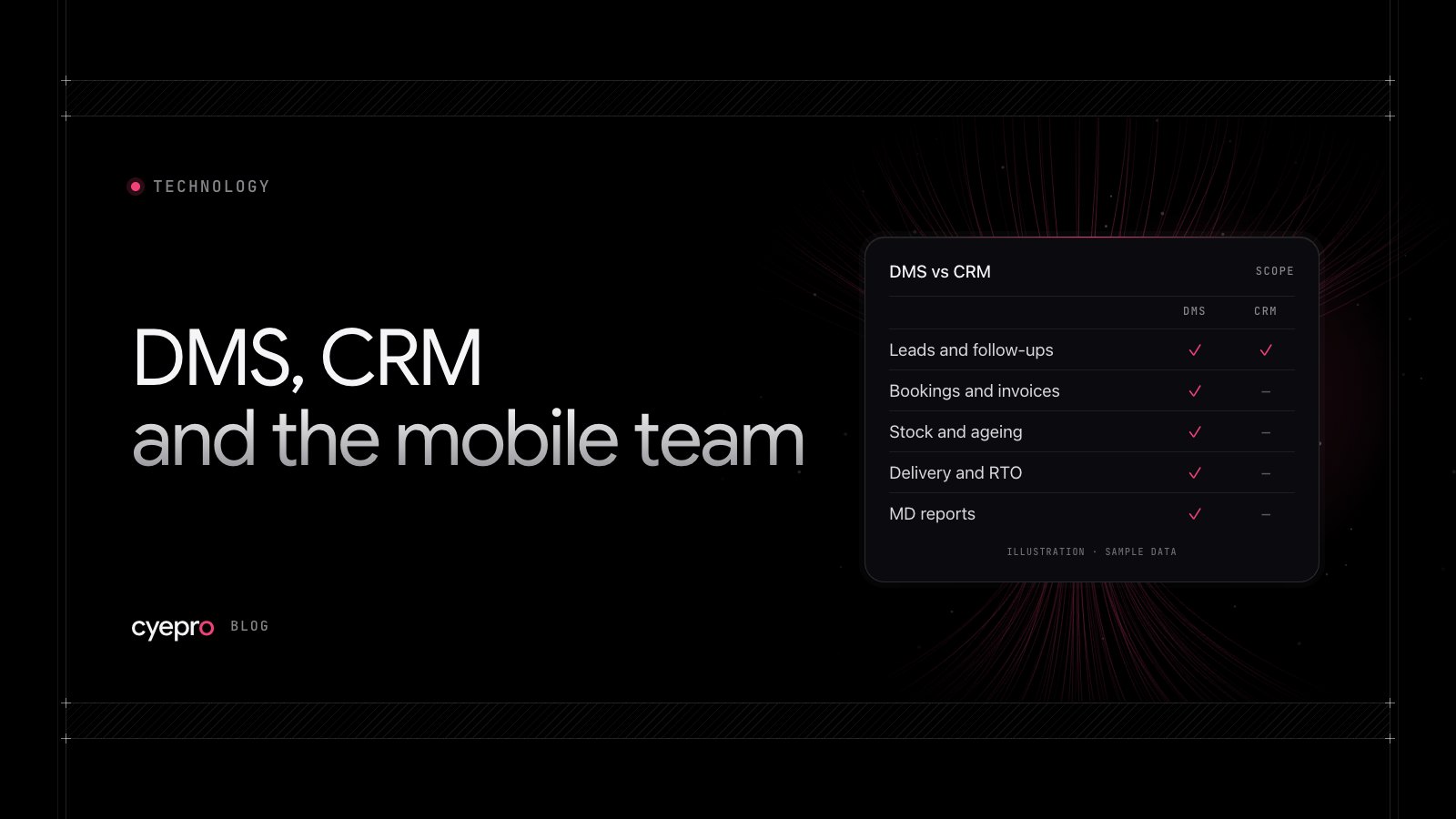
DMS vs CRM: a side-by-side comparison
| Question | CRM | DMS |
|---|---|---|
| Main users | Sales consultants, telecallers, sales managers | The whole dealership: sales, accounts, stock, delivery and the MD |
| Where it starts | First enquiry | First enquiry |
| Where it usually stops | At booking | After delivery, RTO and payment |
| Lead capture and follow-ups | Yes, the core job | Yes, when a CRM is built in |
| Test drives | Yes | Yes |
| Booking approvals and receipts | Sometimes | Yes |
| Stock and allotment | No | Yes |
| Invoice, delivery and RTO | No | Yes |
| Finance, insurance and accessories | Rarely | Yes |
| Accounts and GST/TCS reports | No | Usually |
| The owner's view | Sales funnel only | Funnel plus stock, money and deliveries |
The overlap is the top half of the table. That is why so many owners feel they are choosing between two similar products. They are not. A CRM is one part of the dealership; a DMS is meant to cover all of it.
What CRM do most car dealerships use in India?
There is no reliable public data on dealership software market share in India, so be careful with any article that claims to know "the most used dealership CRM". What you see on the ground is a mix:
- The carmaker's own system. Most OEMs give their dealers a system for the OEM side of the business, such as vehicle orders, billing to the OEM, warranty and the reports the OEM wants to see. Dealers usually have to use it, and it is designed around the OEM's needs, not the showroom's daily routine.
- Generic CRM software. Some dealer groups buy a general-purpose CRM that is sold to every industry and customise it for car sales.
- An automotive CRM or DMS from a specialist vendor. Built for dealerships, with test drives, bookings, approvals and dealership roles already set up.
- Excel and WhatsApp. Still very common, especially for follow-ups and the evening MIS. It costs nothing to start and a lot to run, because nothing connects.
Many dealerships run two or three of these at once. The OEM system holds the official sale, a CRM or a sheet holds the leads, and the MD gets numbers stitched together in Excel at the end of the day.
Do you need a CRM, a DMS or both?
A CRM alone can be enough when
- You run a single showroom with a small sales team
- Your biggest problem is missed follow-ups and leads that nobody calls back
- Your back office (stock, invoice, accounts) already works well and you are happy with it
- You want a quick start for the sales team only
You need a full DMS when
- You have several branches, or more than one brand
- Discounts are given without clear approval, and receipts go missing
- Customers keep calling to ask about their number plate or RC
- Stock is known only to the stock manager, and ageing cars are found too late
- Finance, insurance and accessories income sits in side sheets
- The MD waits until evening, or month end, for numbers that someone builds by hand
If two or more items in the second list sound familiar, a stand-alone CRM will fix the front of the funnel and leave the expensive problems where they are.
How the OEM system, the DMS and the CRM connect
It helps to think of three layers:
- The OEM system is what your carmaker requires. You do not choose it, and a dealer DMS does not replace it.
- The dealer DMS is your own system for running the business your way: your approval rules, your branches, your reports.
- The CRM is the sales part of that, used every hour by the team on the floor and on the phone.
When the CRM is a separate product, the dealership usually re-enters the customer at booking or invoice. Every re-entry is a chance for a different spelling, a wrong phone number or a booking that exists in one system and not the other. When the CRM is part of the DMS, one customer record moves from enquiry to delivery, and only the OEM system needs its own entry.
Before you buy, ask each vendor exactly what moves between systems and how: an automatic link, an Excel export and import, or a person typing. "We integrate" is not an answer. A file format and a live demo are.
The hidden cost of keeping them separate
Running a CRM next to spreadsheets or a second system rarely fails in an obvious way. It fails quietly:
- The booking count in the CRM does not match the count in accounts, and a manager spends the morning reconciling them.
- A discount agreed on WhatsApp never reaches the invoice.
- The MIS takes enquiries from one system and retail from another, so the conversion ratio is never quite right.
- Nobody fully trusts the dashboard, so the MD asks for the Excel sheet anyway.
None of this shows up on a price list, but it is paid for every day in staff time and in decisions made on the wrong numbers.
Buyer checklist: CRM or DMS
Use this list in every demo. Ask the vendor to show each item on screen rather than describe it.
- Can one customer record go from enquiry to delivery and RTO without re-entry?
- Which lead sources come in without typing: website, Facebook and Instagram ads, CarDekho, CarWale?
- How are new leads assigned, and can the rules differ by branch?
- Can a manager approve or reject a discount before the booking is confirmed?
- Does it show stock and stock ageing by branch and model?
- Does it track RTO stages after delivery?
- Does the sales team get a mobile app for iPhone and Android?
- Can the MD see target versus achievement by branch, model and salesperson?
- What can be exported to Excel, and do you keep your data if you leave?
- What does it cost per user per month, and what is included in that price?
Our guide on how to choose a dealer management system in India turns this into a full evaluation, with questions to ask in the demo and red flags to watch for.
Where Cyepro fits
Cyepro DMS is a dealer management system for Indian car dealerships with the CRM built in. The same customer record runs from the first enquiry through test drive, booking approval, invoice, delivery and RTO tracking, with a mobile app for the sales team and dashboards for managers and the owner. You can see how the showroom floor works on our car showroom management software page, and the plans and per-user prices are public on the Cyepro pricing page.
If you are deciding between a CRM and a DMS, the simplest test is to bring one real customer journey from your showroom and watch whether it stays in one system from start to finish. Book a demo and we will walk through it with your own process.
The bottom line
A CRM and a DMS are not rivals. The CRM is the sales front end; the DMS is the whole dealership, ideally with that front end inside it. If your problems stop at missed follow-ups, a good CRM will help. If they continue into approvals, stock, deliveries, RTO and the MD's numbers, choose a DMS that does both jobs in one place.