On this page
- What Makes an Automotive CRM the Right Choice for a Car Dealership?
- Essential Features to Look for in the Best Automotive CRM
- How to Compare Automotive CRM Software for Your Dealership
- Why Lead Management and Follow-Up Matter More Than Feature Count
- Is Cyepro the Right Automotive CRM for Your Dealership?
- Frequently asked questions
Key takeaways
- Choose a CRM around your dealership's actual sales workflow.
- Evaluate lead ownership, customer history, follow-ups and pipeline visibility.
- Test the platform with realistic dealership scenarios and everyday users.
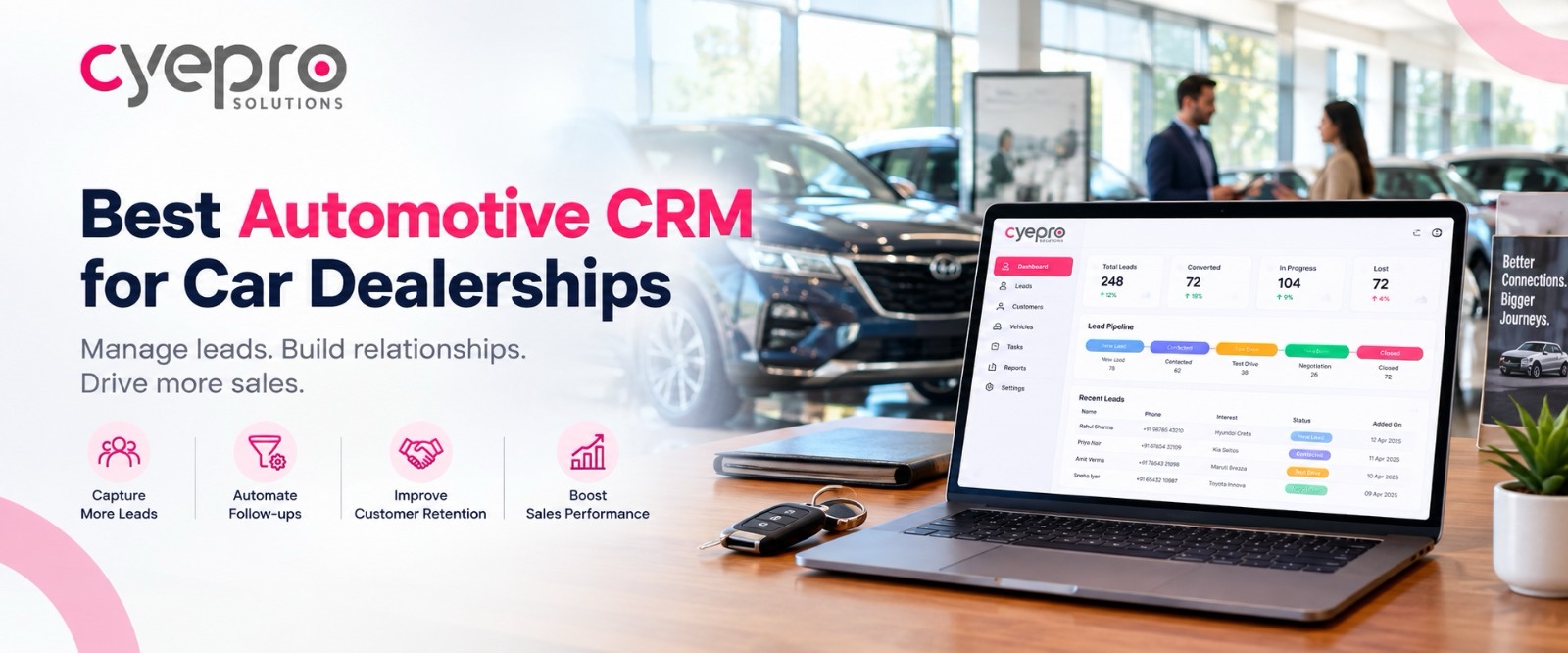
Choosing the best automotive CRM for car dealerships is about more than finding software with a long list of features. Dealerships need a system that can capture enquiries, organise customer information, manage follow-ups, track sales opportunities, and give managers visibility into the sales process. Cyepro is an automotive crm built specifically around these dealership workflows, helping teams manage leads, follow-ups, customer interactions, test drives, sales activity, and reporting from one platform.
A CRM becomes especially valuable when a dealership is handling leads from websites, social media, third-party portals, phone calls, walk-ins, and other channels. Without a structured process, important enquiries can be missed, follow-ups can become inconsistent, and managers may struggle to understand what is happening across the sales team.
So, what should dealerships actually look for when comparing automotive CRM software?
What Makes an Automotive CRM the Right Choice for a Car Dealership?
A general-purpose CRM can store customer information, but automotive sales have specific requirements. Vehicle enquiries often involve model preferences, test drives, quotations, financing discussions, multiple follow-ups, and several stages before a customer books a vehicle.
The best automotive CRM for car dealerships should therefore fit the dealership's actual sales workflow rather than simply offering the largest number of features.
A useful automotive CRM should help your team:
- Capture leads from multiple sources
- Assign enquiries to the right salesperson
- Maintain customer interaction history
- Schedule and track follow-ups
- Manage test drives and appointments
- Track opportunities through sales stages
- Monitor salesperson activity
- Identify pending and overdue actions
- Understand lead sources and sales performance
- Provide managers with useful dashboards and reports
For a deeper explanation of how automotive CRM software works, see our guide to what an automotive CRM is and how dealerships use it.
Read Also: What Is Automotive CRM? A Complete Guide for Car Dealerships
The important point is that CRM software should become part of the daily sales process. It should help salespeople know who to contact, what happened previously, and what needs to happen next.
Essential Features to Look for in the Best Automotive CRM
When comparing automotive CRM software, start with the problems your dealership needs to solve.
1. Multi-Source Lead Capture
Modern dealerships can receive enquiries from several sources. Website forms, social campaigns, third-party portals, phone enquiries, walk-ins, and other channels can all contribute to the sales pipeline.
If these enquiries remain in separate systems, sales managers may have difficulty getting a complete picture of lead activity.
Cyepro describes a workflow that brings enquiries from websites, walk-ins, social media, and third-party portals into one view.
2. Lead Management
Capturing a lead is only the beginning.
A dealership needs to know:
- Where the lead came from
- Who owns it
- What vehicle the customer is interested in
- What communication has already happened
- What stage the opportunity is in
- What the next action should be
This is why car dealership lead management should be a major part of your CRM evaluation.
For a practical process, read our complete guide to car dealership lead management.
Read Also: Car Dealership Lead Management: Complete Guide
3. Follow-Up Management
A large number of dealership opportunities require multiple interactions before a customer makes a decision.
The CRM should make follow-up activity visible rather than leaving salespeople dependent on personal reminders, spreadsheets, or memory.
Cyepro's platform is designed around follow-up tasks and customer engagement workflows, helping teams keep the next action visible.
Learn more about building a consistent process in our car dealership lead follow-up guide.
Read Also: Car Dealership Lead Follow-Up: Practical Guide for Teams
4. Sales Pipeline Management
A dealership should be able to understand where each opportunity sits in the buying journey.
For example:
- New enquiry
- Contacted
- Qualified
- Test drive
- Proposal
- Negotiation
- Booking
- Delivery
The exact stages will differ between dealerships, but the principle remains the same: sales managers need visibility into how opportunities are progressing.
A structured automotive sales pipeline makes it easier to identify opportunities that require attention and understand the overall state of the sales process.
You can explore the topic in our automotive sales pipeline guide for dealerships.
Read Also: Automotive Sales Pipeline: Complete Guide for Dealerships
5. Customer History and Communication
When a customer contacts a dealership multiple times, the salesperson should not have to reconstruct the entire conversation.
A useful CRM keeps relevant customer information and activity together so the sales team can understand previous interactions and continue the conversation with context.
6. Reporting and Analytics
A dealership CRM should also help managers answer practical questions:
- How many leads are currently active?
- Which leads have not been followed up?
- Which salespeople have pending tasks?
- Which sources are generating enquiries?
- How are opportunities progressing through the pipeline?
- Where are opportunities getting stuck?
Cyepro describes dashboards that provide visibility into lead sources, pipeline stages, sales activity, and team performance.
How to Compare Automotive CRM Software for Your Dealership
Finding a CRM isn't simply about comparing feature lists. Two platforms may both advertise lead management, automation, dashboards, and communication tools but work very differently in practice.
Start by documenting your dealership's existing workflow.
Map Your Lead Journey
Write down what happens from the moment an enquiry arrives.
For example:
- Lead received
- Lead assigned
- First contact
- Qualification
- Follow-up
- Test drive
- Quotation
- Negotiation
- Booking
- Delivery
Then ask whether the CRM supports each step.
Check Lead Ownership
Every active enquiry should have a clear owner.
When ownership is unclear, a lead can remain untouched because several people assume somebody else is handling it. A CRM should make responsibility visible to both salespeople and managers.
Evaluate Follow-Up Controls
Ask how the CRM handles:
- Follow-up tasks
- Reminders
- Overdue activities
- Customer communication
- Next-action tracking
- Lead status updates
The objective is not to automate every conversation. It is to make sure important opportunities do not disappear from the team's workflow.
Review Communication Capabilities
If your dealership communicates through WhatsApp, SMS, email, phone calls, or other channels, determine how those interactions fit into the CRM.
Cyepro currently describes WhatsApp, SMS, and email follow-up capabilities alongside real-time alerts.
Test the CRM With Real Dealership Scenarios
During a product demonstration, don't only ask for a feature presentation.
Instead, give the CRM a realistic scenario:
A customer submits an enquiry for an SUV, asks for a test drive, doesn't answer the first call, responds two days later, requests a quotation, and then goes quiet.
Ask the CRM provider to show exactly how that customer would be managed from enquiry through follow-up.
This gives your team a better understanding of whether the platform actually fits its workflow.
For a more detailed feature checklist, read CRM for car dealerships: key features to evaluate.
Read Also: CRM for Car Dealerships: Key Features to Evaluate
Why Lead Management and Follow-Up Matter More Than Feature Count
A dealership can have sophisticated CRM software and still struggle if its sales process is inconsistent.
Imagine two dealerships receiving the same number of enquiries.
In the first dealership, leads are captured in different places. Some are assigned manually, follow-ups are written in notebooks, and managers receive spreadsheet updates.
In the second dealership, every enquiry enters a shared workflow. Ownership is visible, customer interactions are recorded, follow-up tasks are tracked, and managers can review pipeline activity.
The difference isn't necessarily the number of leads.
It is process visibility and consistency.
A good automotive CRM helps turn lead management into a repeatable process. Instead of asking, "Did someone contact this customer?", a manager can look at the customer's record and identify the current status and next action.
Cyepro positions its platform around this type of workflow, bringing lead capture, follow-ups, customer information, sales activity, and reporting into one automotive CRM environment.
This is also why car dealership lead follow-up deserves separate attention. A lead that is captured but not followed up effectively does not create much value for the dealership.
The CRM should make follow-up part of the workflow rather than an afterthought.
Is Cyepro the Right Automotive CRM for Your Dealership?
Cyepro is an automotive CRM platform designed for car dealerships and automotive businesses, with capabilities focused on the dealership sales journey.
The platform currently describes features including:
- Multi-source lead capture
- Lead and customer management
- Follow-up task management
- WhatsApp, SMS, and email communication
- Test-drive management
- Sales pipeline visibility
- Team activity tracking
- Lead-source reporting
- Sales dashboards
- Mobile access
- API-based integration workflows
The benefit of an automotive-focused CRM is that the system can be evaluated around dealership-specific processes rather than generic customer management alone.
For example, a dealership can assess whether the CRM makes it easier to move an enquiry from initial contact through qualification, follow-up, test drive, quotation, booking, and delivery.
You can explore the automotive crm to understand how the platform is designed for dealership workflows.
However, the right CRM ultimately depends on your dealership's size, sales process, lead sources, communication channels, existing systems, and operational requirements.
Before making a decision, involve the people who will actually use the CRM every day. Sales executives, BDC teams, sales managers, and dealership owners may have different requirements.
A successful CRM implementation is not simply about purchasing software. It is about creating a process that your team can consistently follow.
Frequently asked questions
What is the best automotive CRM for car dealerships?
The right automotive CRM depends on the dealership's workflow and requirements. Look for software that can manage lead capture, customer information, follow-ups, sales pipelines, communication, reporting, and team activity in a way that fits your operation.
What should a car dealership look for in CRM software?
Important areas include multi-source lead capture, lead assignment, customer history, follow-up management, sales pipeline tracking, communication tools, reporting, mobile access, and integration capabilities.
Why does a dealership need an automotive CRM?
A CRM can give dealership teams a structured way to manage enquiries, customer interactions, follow-ups, and sales opportunities. It can also give managers greater visibility into sales activity and pipeline stages.
Can an automotive CRM manage leads from multiple sources?
Many automotive CRM platforms support multiple lead sources. Cyepro describes bringing enquiries from websites, walk-ins, social media, and third-party portals into one workflow.
How does CRM improve dealership lead follow-up?
A CRM can connect leads with tasks, reminders, customer history, and next actions. This helps sales teams maintain a structured follow-up process instead of relying entirely on manual notes or memory.
Is an automotive CRM different from a regular CRM?
An automotive CRM is evaluated around dealership-specific workflows such as vehicle enquiries, sales stages, test drives, follow-ups, and customer journeys. The exact capabilities vary between platforms.