On this page
- What Is Car Dealership Lead Follow-Up?
- Start With Context, Not a Generic Message
- Build a Repeatable Follow-Up Sequence
- Choose the Right Communication Channel
- Make Every Follow-Up End With a Next Action
- Use Tasks to Protect Follow-Up Consistency
- Measure the Process Without Turning It Into a Numbers Game
- Common Lead Follow-Up Mistakes
- Practical Example: From Enquiry to Test Drive
- How CRM Supports Automotive Lead Follow-Up
- Cyepro Relevance
- Explore Cyepro
- Conclusion
- Frequently asked questions
Key takeaways
- What Is Car Dealership Lead Follow-Up?
- Start With Context, Not a Generic Message
- Build a Repeatable Follow-Up Sequence
A dealership can generate plenty of enquiries and still struggle to move customers forward if follow-up is inconsistent. One salesperson may call immediately, another may wait, and a third may rely on personal reminders. The result is an uneven customer experience and limited visibility for managers.
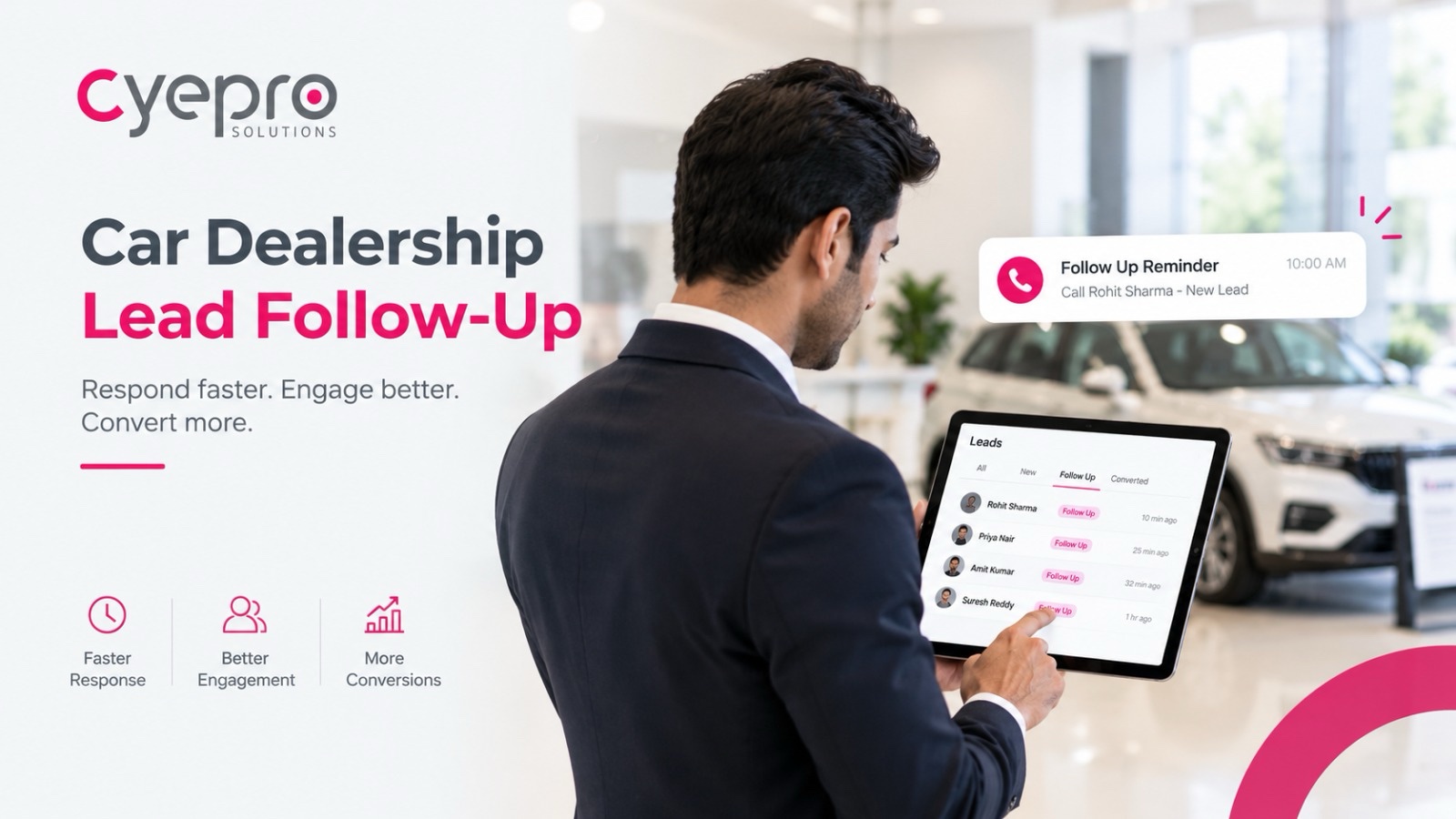
Car dealership lead follow-up is the process of turning an enquiry into a sequence of relevant customer interactions and next actions. Good follow-up is not simply “calling again.” It means knowing the customer's context, choosing an appropriate channel, recording what happened and defining what should happen next.
This practical guide explains how to build a repeatable follow-up process for automotive sales teams and how CRM tools can support the work without replacing the human conversation.
What Is Car Dealership Lead Follow-Up?
Car dealership lead follow-up is the ongoing process of contacting and assisting a customer after an enquiry. It can include calls, messages, emails, appointment coordination, test-drive discussions, quotation follow-up and other actions relevant to the buyer's journey.
The process should answer four questions:
- What does the customer need?
- What has already been discussed?
- What is the next useful action?
- Who is responsible for it?
When those answers are visible, follow-up becomes a managed workflow instead of a series of disconnected reminders.
Start With Context, Not a Generic Message
A customer who asked for a quotation should not necessarily receive the same message as someone who requested a test drive. Before contacting a lead, the salesperson should review the information available in the record.
Useful context can include the enquiry source, vehicle or model interest, previous interactions, customer questions, appointment details and current sales stage.
A short, relevant message is usually more useful than a long generic template. The objective is to continue the conversation, not simply to prove that a message was sent.
Build a Repeatable Follow-Up Sequence
Stage 1: First response
Acknowledge the enquiry and understand what the customer is looking for.
Stage 2: Qualification
Clarify relevant requirements such as vehicle interest, preferred timing and requested information.
Stage 3: Next commitment
Where appropriate, move toward a specific next step such as a call, showroom visit or test-drive discussion.
Stage 4: Follow-up after the interaction
Record what happened and identify the next action.
Stage 5: Longer-term follow-up
If the customer is not ready now, keep the lead in an appropriate future-follow-up process rather than repeatedly treating it as a new enquiry.
The exact timing and sequence should be adapted to the dealership's sales process and customer preferences.
Choose the Right Communication Channel
Different customers may prefer different channels. A dealership can decide which channels are appropriate based on the enquiry and the communication consent or rules applicable to its operation.
Cyepro currently describes automated WhatsApp, SMS and email follow-ups, alongside real-time alerts when leads arrive. This can help teams manage communication from a more structured workflow.
When evaluating any automation, ask what the system actually records, how templates are managed, how users control timing, and how the team avoids sending irrelevant or repetitive messages.
Make Every Follow-Up End With a Next Action
A useful CRM note does more than say “customer contacted.” It should help the next person understand the situation.
Compare:
“Spoke to customer.”
with:
“Customer is comparing two variants and asked for a quotation. Follow up after the weekend.”
The second note gives the team context and a clear reason for the next interaction. The CRM should make this type of structured update easy to record.
Use Tasks to Protect Follow-Up Consistency
Personal memory is not a reliable dealership operating system. Salespeople handle multiple customers, appointments and internal requests every day.
Task management creates a visible reminder tied to the customer record. Managers can also use task visibility to identify overdue work or leads without a defined next action.
Cyepro currently describes automated task tracking and intelligent follow-ups designed to keep teams on schedule. Whether using Cyepro or another CRM, define a small set of task types and make ownership clear.
Measure the Process Without Turning It Into a Numbers Game
Follow-up reporting should help managers find process problems. Useful operational questions include:
• Are new enquiries being contacted and assigned? • Which leads have no next task? • Which follow-ups are overdue? • Which opportunities have been inactive? • Are salespeople consistently recording meaningful interaction notes? • Are leads progressing through the defined sales stages?
Avoid building a dashboard around metrics nobody can act on. A good report should point a manager toward a decision or intervention.
Common Lead Follow-Up Mistakes
Templates can save time, but relevance still matters. Use templates as a starting point rather than a substitute for customer context.
Following up without recording the conversation
If the next salesperson cannot see what happened, the customer may have to repeat information.
Leaving the next action undefined
“Follow up later” is not a useful task. Define what needs to happen and when it should be reviewed.
Over-automating communication
Automation should support the workflow. It should not create repetitive communication that ignores the customer's situation.
Treating every lead as equally active
Some customers need immediate attention; others have clearly indicated a later timeline. The workflow should reflect those differences.
Practical Example: From Enquiry to Test Drive
A customer submits a website enquiry about an SUV and asks whether a test drive is available. The lead enters the dealership workflow and is assigned to a salesperson.
The salesperson reviews the enquiry, contacts the customer and learns that the customer wants to compare two variants. The salesperson records the conversation and creates the next task: confirm the preferred test-drive time.
After the appointment, the interaction is updated again. If the customer requests a quotation, that becomes the next action. At each point, the record shows the latest context rather than relying on separate notebooks or messages.
This is what a structured automotive lead follow-up process looks like: each interaction creates useful context for the next one.
How CRM Supports Automotive Lead Follow-Up
A CRM can support follow-up in several connected ways:
• Centralising customer and enquiry information. • Assigning follow-up responsibility. • Creating and tracking tasks. • Maintaining interaction history. • Supporting available communication channels. • Alerting teams when new leads arrive. • Giving managers visibility into activity and pending work.
Cyepro currently describes multi-channel lead capture, WhatsApp/SMS/email follow-ups, real-time alerts, Lead 360°, task management and real-time dashboards. These capabilities can be assessed against the dealership's actual follow-up process rather than evaluated as isolated features.
Cyepro Relevance
Cyepro is positioned as an all-in-one automotive CRM for car dealerships and states that it centralises leads, follow-up tasks, customer conversations and sales reporting. Its current website also describes mobile access and API-based integration workflows.
For teams looking to make follow-up more consistent, the relevant question is how these capabilities fit the dealership's existing process, people and systems. A practical evaluation should use real lead scenarios and real follow-up steps.
Explore Cyepro
If your sales team is finding it difficult to keep follow-ups consistent, map the process from first enquiry to the next customer commitment. Then compare that workflow with Cyepro's current lead, task, communication and dashboard capabilities. See a live demo.
Conclusion
Consistent car dealership lead follow-up comes from a repeatable process, useful customer context and clear next actions. The salesperson still provides the relationship and judgement; the system provides structure around the work.
Start by defining the follow-up stages your dealership actually uses. Then make ownership, task management and interaction history part of the daily process. A CRM can help bring those elements together so sales teams spend less time reconstructing what happened and more time having relevant customer conversations.
Frequently asked questions
How often should a dealership follow up with a lead?
There is no single schedule that fits every customer. Follow-up should reflect the enquiry, customer preference, stage and agreed next action.
What should a salesperson record after a follow-up?
Record the useful outcome: what the customer said, what information was requested, what stage the opportunity is in and what should happen next.
Can automated follow-up replace personal calls?
Automation can support reminders and selected communications, but customer conversations still require human judgement and context.
Why do dealership follow-ups get missed?
Common causes include unclear ownership, manual reminders, disconnected lead sources, incomplete records and no visible next action.
What should managers monitor?
Focus on operational visibility such as assignment, pending tasks, overdue follow-ups, inactive opportunities and stage movement.