On this page
- What Is the Best CRM for a Toyota Car Dealership?
- How Toyota Dealerships Can Turn Enquiries Into Organised Sales Opportunities
- Managing Long Customer Journeys With Better Follow-Up
- What Should Toyota Dealership Managers Measure in a CRM?
- How to Choose CRM Software for a Toyota Dealership
- Why Cyepro Is Relevant to Toyota Dealership CRM Requirements
- Frequently asked questions
Key takeaways
- Connect each Toyota enquiry with a clear owner and next action.
- Keep customer history visible throughout longer sales journeys.
- Evaluate CRM software against real dealership workflows and reporting needs.
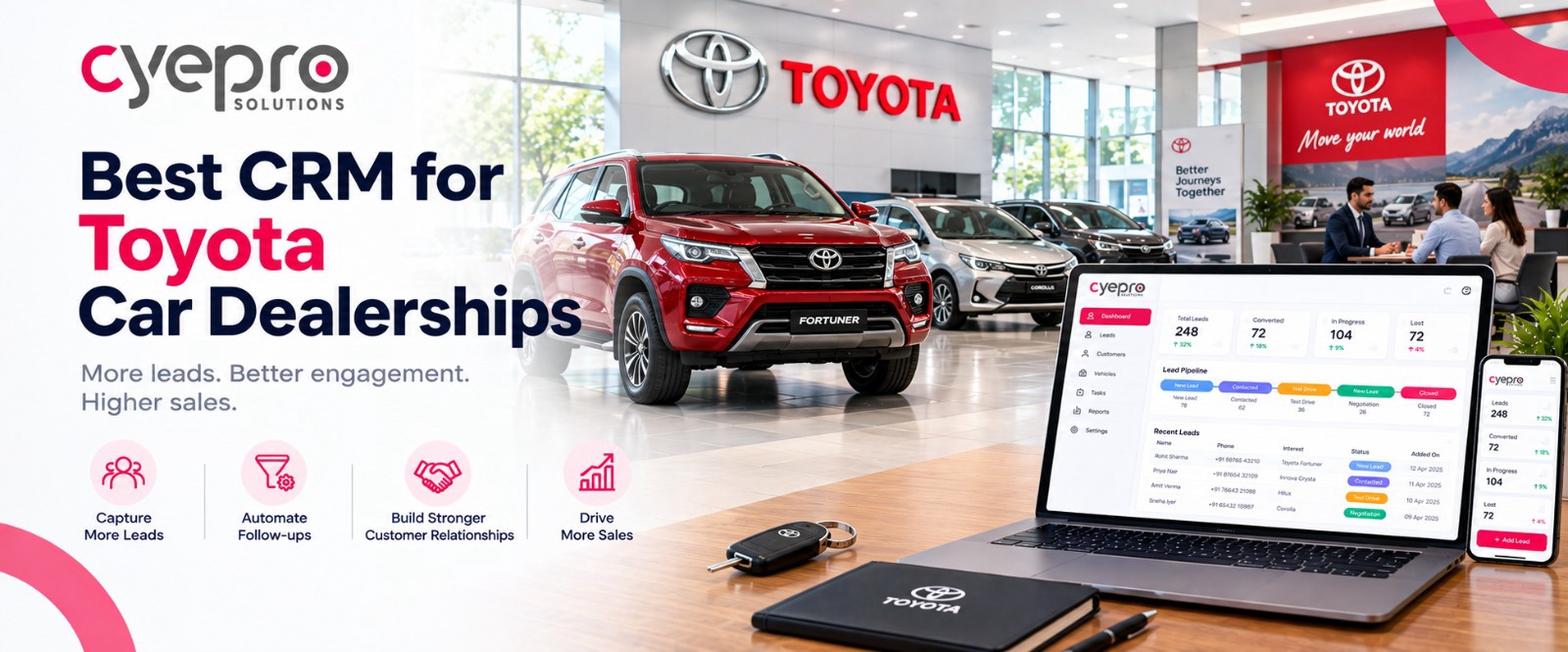
Choosing the best CRM for Toyota car dealerships starts with a simple question: can your dealership consistently manage every customer enquiry from the first conversation to the final sale? Toyota dealers may receive enquiries through websites, digital advertising, social media, automotive marketplaces, phone calls, referrals, and showroom visits. Cyepro is an automotive crm platform designed for dealerships that brings lead management, customer information, follow-ups, sales activity, and pipeline visibility into a structured workflow.
For a Toyota dealership, CRM software should do more than store names and phone numbers. It should help the sales team understand customer requirements, organise opportunities, maintain communication history, schedule follow-ups, and give management a clear view of dealership activity.
What Is the Best CRM for a Toyota Car Dealership?
The best CRM for a Toyota dealership is one that fits the dealership's sales process and makes customer management easier for both salespeople and managers.
A useful dealership CRM should answer these questions quickly:
- Where did the customer enquiry come from?
- Which salesperson is responsible for it?
- What Toyota vehicle is the customer interested in?
- Has the customer been contacted?
- What did the customer discuss?
- Is a test drive required?
- When is the next follow-up?
- What stage is the opportunity in?
- What action should happen next?
This is the difference between a customer database and a dealership CRM.
A database can store information. A CRM can connect that information with activities, follow-ups, opportunities, and sales processes.
For dealerships that want to understand the broader role of automotive CRM, our automotive CRM guide for car dealerships provides a useful starting point.
Read Also: Automotive CRM Guide for Car Dealerships
What Should a Toyota Dealer CRM Do?
At a practical level, CRM software should help the dealership manage:
- Lead
- Customer
- Interaction
- Follow-Up
- Test Drive
- Opportunity
- Negotiation
- Booking
- Delivery
The exact workflow can vary from one dealership to another, but the CRM should make the customer's current position visible.
How Toyota Dealerships Can Turn Enquiries Into Organised Sales Opportunities
A Toyota dealership can receive enquiries from many different sources. The problem isn't necessarily generating leads; it is ensuring that every relevant enquiry enters a process that someone owns.
Imagine a customer searching online for a Toyota vehicle and submitting an enquiry outside normal showroom hours.
The CRM workflow should make it possible to:
- Capture the enquiry.
- Record the customer's information.
- Identify the requested vehicle or requirement.
- Assign the enquiry to a salesperson.
- Record the first interaction.
- Schedule the next action.
- Move the opportunity through the sales pipeline.
- Maintain the customer's interaction history.
This creates a single customer journey instead of several disconnected activities.
For a dealership manager, that means fewer questions such as:
- "Who is handling this lead?"
- "Did anyone call this customer?"
- "When is the next follow-up?"
- "Why is this opportunity still open?"
The answers can be available within the CRM.
Our car dealership lead management guide explores this process in greater detail.
Read Also: Car Dealership Lead Management: Complete Guide
Why Lead Source Tracking Matters
A Toyota dealership may invest in multiple marketing channels.
CRM lead-source tracking can help managers understand where enquiries are coming from and connect those enquiries with sales activity.
Instead of looking only at the total number of leads, dealership teams can examine the journey from source to opportunity.
That provides more useful information for sales and marketing decisions.
Managing Long Customer Journeys With Better Follow-Up
Buying a vehicle is rarely a single-interaction process.
A potential Toyota customer might initially request information, later ask about a different variant, schedule a showroom visit, complete a test drive, request a quotation, and then take additional time before making a decision.
This creates a challenge for salespeople: how do you maintain continuity when the customer journey stretches across multiple conversations?
A CRM can help by keeping customer activity connected.
For example:
- Initial enquiry
- Customer requirement recorded
- First call completed
- Follow-up scheduled
- Test drive arranged
- Customer feedback recorded
- Quotation shared
- Follow-up scheduled
- Opportunity updated
The salesperson can refer to the customer's history before the next conversation rather than relying on memory.
This is particularly useful when a customer speaks to different members of the dealership team.
For more information, see our car dealership lead follow-up guide.
Read Also: Car Dealership Lead Follow-Up: Complete Guide
What Makes CRM Follow-Up Effective?
Effective follow-up is not simply about contacting customers repeatedly.
It is about knowing:
- Who needs attention
- Why they need attention
- When they should be contacted
- What was discussed previously
- What the next useful action should be
A CRM can provide the structure needed to make those activities visible.
What Should Toyota Dealership Managers Measure in a CRM?
Sales managers need more than a list of active customers.
They need to understand what is happening across the dealership.
A useful CRM can help management examine areas such as:
- Lead Activity: How many new enquiries are entering the dealership?
- Lead Ownership: Are enquiries being assigned clearly to salespeople?
- Follow-Up Activity: Which opportunities have upcoming or overdue actions?
- Pipeline Movement: Are opportunities progressing through the sales process?
- Lead Sources: Which channels are generating enquiries?
- Salesperson Activity: How are individual team members managing their assigned opportunities?
These insights can help managers identify operational bottlenecks.
For example, if many opportunities are sitting at the same sales stage, management can investigate why those opportunities are not progressing.
This makes CRM reporting a management tool rather than simply an administrative feature.
Our automotive sales pipeline guide explains how dealerships can structure and monitor their sales opportunities.
Read Also: Automotive Sales Pipeline: Complete Guide
How to Choose CRM Software for a Toyota Dealership
There is no single CRM that automatically fits every Toyota dealership.
The right choice depends on the dealership's lead volume, team structure, sales process, communication channels, existing technology, and reporting requirements.
Before selecting a platform, evaluate it against these practical questions.
Can It Handle Your Lead Sources?
Check whether the CRM can accommodate the channels that generate enquiries for your dealership.
Can Salespeople Use It Quickly?
A CRM that takes too many steps to update can become difficult to adopt.
Sales executives should be able to view customer information, record activity, and manage follow-ups without unnecessary complexity.
Does It Provide Customer Context?
A useful customer record should show relevant previous interactions and current sales status.
Can Managers See the Pipeline?
Managers should be able to understand where opportunities are and which activities require attention.
Does It Support Communication?
Evaluate whether the platform supports communication workflows relevant to your dealership, such as email, SMS, WhatsApp, calls, and other customer interactions.
Can It Provide Useful Reports?
Reporting should help answer business questions rather than simply produce large amounts of data.
For a more detailed checklist, explore our guide to CRM features for car dealerships.
Read Also: CRM for Car Dealerships: Key Features to Evaluate
Why Cyepro Is Relevant to Toyota Dealership CRM Requirements
Cyepro is an automotive CRM platform designed for car dealerships and automotive businesses.
Its CRM workflow focuses on areas such as:
- Lead management
- Customer management
- Lead-source tracking
- Follow-up management
- Sales pipeline management
- Test-drive management
- Customer communication
- Sales activity
- Reporting and analytics
For a Toyota dealership evaluating CRM platforms, the important question is not simply whether the software contains these features.
The more useful question is:
Can the platform connect these activities into one dealership workflow?
A salesperson should be able to move from a new enquiry to customer engagement, follow-up, test drive, sales opportunity, and booking while maintaining the customer's information and activity history.
Managers should then be able to view the overall pipeline and sales activity.
You can explore the Cyepro automotive crm to understand how the platform approaches dealership CRM.
The final decision should be based on your dealership's specific requirements and how well the platform performs with real-world customer scenarios.
Frequently asked questions
What is the best CRM for Toyota car dealerships?
The right CRM depends on the dealership's sales process, lead sources, team structure, communication requirements, and reporting needs. A suitable automotive CRM should make lead management, customer tracking, follow-ups, pipeline management, and reporting easier.
What does a Toyota dealership CRM do?
A Toyota dealership CRM helps organise customer enquiries, assign leads, maintain customer records, track interactions, manage follow-ups, and monitor sales opportunities.
Why is CRM important for Toyota dealers?
CRM software can provide a structured system for managing customer relationships and sales opportunities, particularly when a dealership receives enquiries through multiple channels.
How does CRM help Toyota dealership sales teams?
It can give salespeople access to customer history, assigned leads, pending activities, follow-up information, and sales-stage details in one place.
What CRM features should Toyota dealers look for?
Important capabilities include lead capture, lead assignment, customer management, follow-up tracking, sales pipeline management, test-drive management, communication tools, reporting, and analytics.
Can Cyepro be used as an automotive CRM for Toyota dealerships?
Cyepro is designed as an automotive CRM for car dealerships and automotive businesses. Toyota dealerships can evaluate the platform based on their own sales workflow, lead sources, team requirements, and operational needs.